
The Bookseller of Kathmandu - Inspirations
The Bookseller of Kathmandu is set in two different locations and two time-zones and the inspirations behind the story came from many different sources.
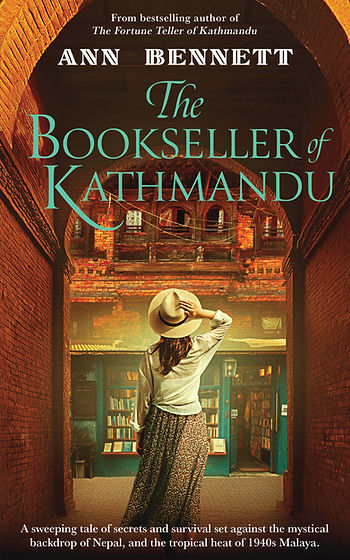
I’ve wanted to write about Kathmandu since I first travelled to Nepal in 1987 when I was on a long trip round India and Southeast Asia. I was enchanted by Kathmandu, especially the narrow old streets of Thamel and the ancient heart of the city, Durbar Square. Thamel was a maze of pedestrianised streets and alleys, lined with medieval buildings, thronging with people. It was crammed full of shops, temples and street stalls.
The atmosphere, especially during the smoke-filled evenings was magical. My friend and I arrived by bus from Pokhara after a long trek through the Annapurna Range and spent several lazy days there. We stayed at the Kathmandu Guest House, in those days a backpacker hostel, eating in the many cafes and visiting all the sites of the Kathmandu Valley.

Since then, Nepal suffered a devastating earthquake in 2015, destroying many of the ancient temples and streets in Thamel. Some of these have been rebuilt, but for a long time, Thamel and Durbar square were badly damaged, and even now, ten years on, the effects are still apparent.

I first wrote about Nepal in The Fortune Teller of Kathmandu, published in 2023, which tells the story of Chloe, a thirtysomething British woman, who travels to India and Nepal to retrace the footsteps of her grandmother, Lena. Lena worked for a Gurkha recruiting officer during World War II, travelling to the forbidden kingdom of Nepal with him to recruit men for the front in Burma.
The Bookseller of Kathmandu, although a standalone story, is in part a follow-up to that book.
Chloe is married to Kiran, a Nepalese tour guide, and has bought a quirky old bookshop in Thamel. The inspiration for Paradise Books, was Pilgrim’s Book House in Thamel. A narrow old shophouse, with three stories packed full of books of every kind.
In the story, Chloe is approached by Rajesh Desai, a distant cousin of Kiran’s. His father, Anil, has just died and Rajesh asks Chloe if she will take his father’s old books from him.
Chloe is surprised to discover that Anil’s home is a crumbling Rana palace. When she starts looking through the books, she finds a cache of fading letters. They are from a British woman, Alice Lacey, living on a mining estate in Malaya, to Anil, who was serving with the Gurkhas during the Malayan Emergency of the 1940. The inspiration for Anil’s home is the hotel I stayed in while researching both books. It is called the Shanker Hotel, itself a restored Rana palace. Full of panelled rooms, chandeliers and sweeping staircases, it seems to belong to a former era.

The book is partly set in British Malaya of the late 1940s, where Alice Lacey is living with a volatile husband through a time of danger. Her developing friendship with Anil provides some light during those dark days.
I have also travelled to Malaysia several times, the first time in 1985 on an overland trip between Bangkok and Bali, staying in Penang and Malacca en route for Singapore.
I was first inspired to visit because my father served in the British Indian Army in the Malaya Campaign during WWII. He was taken prisoner by the Japanese at the Fall of Singapore and transported to work on the Thai-Burma railway. I have travelled there since, to research his story, on several occasions.

I set my first book, Bamboo Heart, partly in British Malaya in the lead up to the Japanese invasion, mainly in Penang, and my second book, Bamboo Island, on a rubber plantation near Kuala Lipis and in Singapore.
I’ve written several books subsequently about WWII in Southeast Asia and during my research I began to read about the Malayan Emergency. Chinese communists, trained by the British as guerillas to wage war against the Japanese, turned against their former allies in an attempt to oust British rule and impose communism on Malaya. The resulting conflict lasted twelve years and has often been compared to the Vietnam war.
When I did start to read about the decline of British rule in Malaya and the Emergency, I began to wonder how it had affected the lives of ordinary people. So, I created the character of Alice, a naïve British woman, living on an isolated tin mine, caught up in those turbulent events, who is thrown together with a Gurkha officer assigned to protect her home.
I hope you enjoy The Bookseller of Kathmandu and that it transports you to the backstreets of Kathmandu and to the jungles of 1940s Malaya. If you are interested in finding out more about my books, please visit my website.


Comments